The best feed mix for backyard pigs in the Philippines is a balanced grower ration of about 36% rice bran D1, 30% cracked corn, 15% copra meal, 10% soybean meal, 3% fish meal, plus concentrate and salt. That hits the 16% crude protein a grower needs at roughly ₱22-26/kg, versus ₱35-38/kg for commercial grower-finisher pellets (₱1,747-1,910 per 50 kg bag, July 2026). Feed is about 57% of a hog operation's running cost, per PIDS, not the 60-70% you see repeated everywhere, so the gap still matters.
A home-mixed ration using locally available ingredients costs roughly 30-40% less than full commercial feed, and Philippine research from UPLB shows it produces acceptable growth rates for backyard operations. The catch is the protein. The cheap corn-and-darak recipes floating around online test at 12-13% protein and quietly stretch your grow-out by weeks.
"Lisod gyud magpadako ug baboy kung sayop ang pakan-on." (It is difficult to raise pigs if the feed is wrong.)
Get the protein and energy balance right and the math works. Here is how.
A Simple Backyard Feed Formula
This formula works for grower pigs (20–60 kg) in Philippine backyard conditions. It uses ingredients available in most town markets and agricultural supply stores. The crude protein column shows what each ingredient actually contributes, so you can see the mix really lands at 16%, not just take my word for it:
| Ingredient | Proportion | CP value | CP contribution | Role |
|---|---|---|---|---|
| Rice bran (D1/darak) | 36% | 12% | 4.32% | Energy base, widely available |
| Cracked corn (mais) | 30% | 8% | 2.40% | Main energy source |
| Copra meal (soaked) | 15% | 21% | 3.15% | Local protein, fiber-limited |
| Soybean meal (44%) | 10% | 44% | 4.40% | The protein that hits 16% |
| Fish meal (local, ~60%) | 3% | 60% | 1.80% | Lysine and methionine top-up |
| Commercial concentrate | 4% | n/a | premix | Vitamins and trace minerals |
| Iodized salt | 1% | n/a | n/a | Electrolytes |
| Total | 99% | ~16.1% CP | ~3,050 kcal/kg ME |
Computed crude protein: ~16%, the level a 20–60 kg grower needs per NRC (2012) and the Merck Veterinary Manual. Feed chopped camote tops or kangkong fresh on the side (2–3 kg/day per grower) for vitamins. Treat the greens as a supplement, not part of the protein math, since most of that weight is water.
The single most important line in this whole article: the 10% soybean meal is not optional. Pull it out to save a few pesos and the mix drops to about 12–13% protein. That grows a fat, slow pig and stretches your grow-out by weeks, which costs far more than the soybean meal ever saved. The pig feed formulation guide shows the same math worked two ways.
Formulas by Growth Stage
The grower formula above is your workhorse. But pigs at different stages need different protein levels. Here are adjusted formulas:
Starter (weaned to 20 kg, 18–20% CP)
For just-weaned piglets, honestly, buy commercial starter feed (B-MEG Starter, Vitarich, or similar at ₱36–44/kg) for the first 2–4 weeks. Piglets eat so little at this stage, maybe 0.5–1.0 kg/day, that the cost difference is small and the risk of a bad home mix causing scours is not worth it. The pre-starter and starter phases need lysine-rich, highly digestible protein that copra meal and rice bran simply cannot deliver. Transition to your home mix once they hit 15–20 kg.
If you insist on mixing your own starter, you have to push real protein hard: soybean meal up to 18%, fish meal to 8%, rice bran down to 25%, corn at 25%, copra meal capped at 8% (young pigs handle fiber poorly). That gets you near 18% CP. Even then, I would not recommend it for beginners. The starter phase is only 15–20% of total feed cost anyway, so the savings barely move the needle.
Grower (20–60 kg, target ~16% CP)
Use the main formula table above. This is where home mixing saves the most money because growers eat the most feed over the longest period, roughly 80–120 kg of feed per pig in this phase alone.
Finisher (60–100 kg, target ~14% CP)
| Ingredient | Proportion | CP value | CP contribution | Change from Grower |
|---|---|---|---|---|
| Rice bran (D1) | 40% | 12% | 4.80% | +4% |
| Cracked corn | 33% | 8% | 2.64% | +3% |
| Copra meal | 13% | 21% | 2.73% | -2% |
| Soybean meal (44%) | 6% | 44% | 2.64% | -4% |
| Fish meal | 2% | 60% | 1.20% | -1% |
| Commercial concentrate | 4% | n/a | premix | Same |
| Iodized salt | 1% | n/a | n/a | Same |
| Total | 99% | ~14.0% CP | ~3,150 kcal/kg ME |
Less protein, more energy. The pig is laying down fat and final weight, not growing frame. Note that "less protein" still means about 14%, not the 10–11% a corn-and-copra-only mix produces. The soybean meal stays in, just at a lower rate. Drop it entirely and a finisher stalls just like a grower does. For the finishing phase specifically, the pig feed formulation guide carries a fuller finisher worksheet.
What Each Ingredient Costs
Prices vary by region and season, but here are typical ranges as of 2025–2026:
| Ingredient | Price/kg | Where to Buy | Notes |
|---|---|---|---|
| Rice bran (D1/darak) | P14–20 | Local rice mill | Buy fresh, goes rancid in 2 weeks |
| Cracked corn (mais) | P20–25 | Agricultural supply, Bukidnon/Isabela traders | Farmgate is P18–23, retail is higher |
| Copra meal | P14–20 | Coconut oil mills, copra traders | Prices climbed hard through 2025, per Philippine Coconut Authority reporting. Confirm with your local mill. |
| Soybean meal (44%) | P30–38 | Feed store, larger agri-supply | Imported, so price tracks the peso. The reliable way to actually hit 16% protein. |
| Fish meal (local dried) | P60–95 | Agricultural supply, fishing towns | Huge quality variation. Smell it before buying. |
| Camote tops / kangkong | Free–P5 | Your own farm, neighbors, wet market | Best free vitamin source in PH; mostly water, not a protein backbone |
| Commercial concentrate | P40–55 | Feed store (B-MEG, Vitarich, Pilmico brands) | Small amount goes a long way |
| Molasses (optional) | P30–60 | Sugar mill areas, agricultural supply | Good palatability booster |
Those ranges are what I see at rice mills and agri-supply counters. BAI publishes the wholesale side of the same market every week, and we archive it with the retrieval date on every row: copra meal, US soybean meal and local fishmeal. Wholesale runs under what you pay by the sack, so read it for direction rather than for your own budget. The fishmeal series is the one to look at before you buy: BAI's local fishmeal column was sitting near ₱93 a kilo when the source stopped printing it in May 2026, the top end of the range in the table above. That is why 3% inclusion is the right number and 8% is not.
Blended Cost per Kg (Grower Formula)
Using midpoint prices on the corrected 16% formula: (36% × P17) + (30% × P22) + (15% × P17) + (10% × P34) + (3% × P78) + (4% × P48) + (1% × P15) = about P23/kg of mixed feed, call it the P22–26/kg range once local prices move around.
Compare that to P35–38/kg for a commercial complete grower-finisher like B-MEG, which is P1,747–1,910 per 50 kg bag as of July 2026 (mean about P36.70/kg). That is roughly P10–15/kg savings. At 2 kg daily intake, call it P20–30 per pig per day after you account for the soybean meal you can't skip. Millers pushed feed up P1–2/kg through 2026 and nobody has announced a rollback, so treat that gap as the floor, not the ceiling.
How to Actually Mix This
You do not need a feed mill. Most backyard farmers mix by hand on a clean concrete floor or in a large basin.
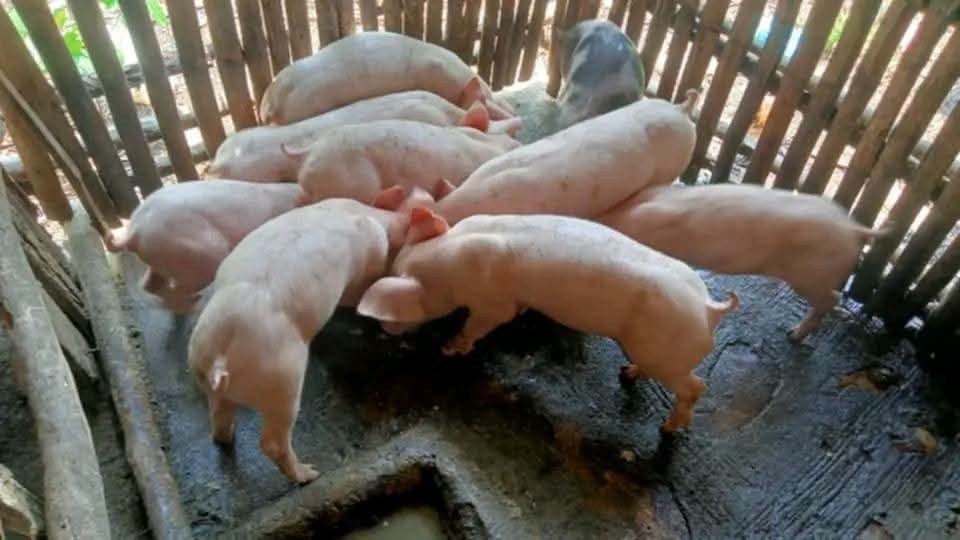
Batch size: Mix 50 kg at a time. That is enough for 2–3 grower pigs for about 8–10 days. Do not mix more than you will use in 2 weeks, especially during rainy season when moisture causes mold.
Method:
- Weigh each ingredient. A P200 hanging scale from the hardware store works fine.
- Spread the rice bran as the base layer on clean concrete or a large tarp.
- Add corn, copra meal, and fish meal on top. Mix dry first, turning with a shovel until the color is uniform. Takes about 5–10 minutes.
- Chop greens finely and mix in last. Some farmers wilt the greens in the sun for a few hours first to reduce moisture.
- Add commercial concentrate and mix again.
- Store in sealed sacks or plastic drums off the ground. Label with the date.
Wet vs dry feeding: You can feed this mix dry in a trough, or add water at feeding time (roughly 1:1 ratio) to make a wet mash. Wet mash reduces dust and some pigs eat it more eagerly, but it spoils within hours in Philippine heat. Only mix wet what the pigs will finish in one meal.
Why These Ingredients Work
Rice bran (darak) is the backbone of most backyard feed systems in the Philippines. UPLB research measured it at 4,137 kcal/kg digestible energy with 87% digestibility in Philippine native pigs. D1 rice bran (first pass from the mill) has about 12–13% crude protein and is available at practically every rice mill in the country for P14–20/kg.
Warning: Rice bran goes rancid quickly in Philippine heat. Buy only what you will use within 2 weeks. Store in a cool, dry place in sealed containers. Rancid rice bran smells sour and pigs will refuse it.
Copra meal is cheap and available throughout coconut-producing regions, especially Visayas, Mindanao, and Bicol. At 20–22% crude protein, it is the most cost-effective local protein source. Soak it in water for 8–24 hours before mixing to improve digestibility. Note: copra meal prices have been volatile since 2025 due to tight global coconut oil supply, so check current local prices before budgeting.
UPLB-BIOTECH has also developed Protein-Enriched Copra Meal (PECM), which boosts copra meal protein content from 20% to 44% through microbial treatment. If PECM becomes commercially available in your area, it could replace both copra meal and some fish meal in the formula.
Soybean meal (44%) is the ingredient that does the real work in this formula. At about 44% crude protein with a strong lysine profile (roughly 2.8% lysine versus copra meal's 0.55–0.65%), it is what pulls a copra-and-darak mix from 12–13% up to the 16% a grower needs. It is imported, so the price tracks the peso, but at 10% inclusion a little goes a long way. Anyone selling you a corn-copra-darak "complete" feed without it is wrong, and the pig feed formulation guide shows exactly why with the worked numbers.
Fish meal is the most expensive ingredient at P60–95/kg, but you use very little (3% of the mix). It tops up lysine and methionine alongside the soybean meal. Buy from reputable agricultural suppliers, not wet market sweepings. Quality varies hugely and bad fish meal introduces more problems than it solves.
Camote tops (sweet potato leaves) and kangkong are excellent free vitamin and mineral sources, not a protein backbone. The 14–20% protein figures you see quoted are on a dry-matter basis. Fed fresh, they are mostly water (often only 3–4% protein as fed), so treat 2–3 kg of chopped greens a day as a vitamin top-up on the side, not a substitute for soybean meal. Both grow abundantly in Visayas and Mindanao and cost nothing if you have even a small patch of land.
When Home-Mixing Does NOT Make Sense
Real talk: home-mixing is not always the better choice.
- If you have fewer than 3 pigs. The ingredient minimum order quantities (50 kg sack of rice bran, 25 kg copra meal) mean you will have leftover feed going rancid before you use it. For 1–2 pigs, commercial feeds in smaller bags are simpler and the total cost difference is small.
- If you cannot source soybean meal, copra meal, or fish meal locally. Without a real protein concentrate, your mix is just expensive pig candy. Corn and rice bran alone test at 12–13% protein and make a fat, slow-growing pig.
- If you have no storage. Home-mixed feed needs a dry, cool, pest-free storage area. If your only option is an open corner of the bahay kubo, buy commercial feeds and skip the mold risk.
- If your time is worth more elsewhere. Mixing 50 kg takes 30–45 minutes. Sourcing ingredients means trips to the rice mill, copra trader, and feed store. If you can earn more working during that time than you save on feed, buy commercial.
For everyone else, especially farmers running 5–20 heads in Visayas or Mindanao where copra meal and rice bran are cheap and abundant, home-mixing is still the most practical way to control feed costs.
Common Mistakes
- Relying only on kitchen scraps. Scraps are unpredictable in nutrition. They supplement, they do not replace, a balanced ration.
- Storing rice bran too long. After 2 weeks in Philippine heat, it degrades. Buy fresh and frequently.
- No protein source. Corn + rice bran alone gives you energy but not enough protein. Pigs grow slowly and get fat instead of muscular.
- Feeding raw cassava with skin. The skin contains cyanide compounds. Always peel and cook cassava before feeding.
- Sudden feed changes. Switching from commercial to home-mixed overnight causes diarrhea. Transition gradually over 5–7 days.
- Not cooking swill (kitchen waste). Uncooked swill containing meat scraps is a major ASF transmission risk. Always boil kitchen waste thoroughly before feeding.
How Much Does It Cost?
The blended cost and savings math is in the ingredient cost table above. Bottom line: for a single grower pig eating about 2 kg of feed per day, a balanced home mix saves roughly ₱20–30 per day after you pay for the soybean meal you cannot skip. Over a 3-month grow-out, that is about ₱1,800–2,700 per pig. On a 10-head batch, ₱18,000–27,000 in total savings. That is not pocket money right now. Farmgate liveweight has been running about ₱180–190/kg in mid-2026 (SINAG industry average) while cost of production sits near ₱180/kg, so the average farm is selling at roughly its own cost. Feed is where the margin comes from, if it comes at all. Just don't chase the bigger ₱4,000-per-pig figures floating around online. Those assume a mix too low in protein to finish a pig on time.
Use the Feed Cost Calculator to estimate your specific costs based on local prices, or try the Quick Feed Estimate tool for a fast calculation of how much feed your pigs need per day.
Free Tool
Feed Cost Calculator
Plug in your local rice bran, copra meal, and corn prices to see exactly what this home-mix formula costs per kg of pig gain in your area.
Bisaya / Cebuano
Para sa mga mag-uuma
Ang balanced nga formula para sa grower (20-60 kg, mga 16% protina):
- 36% darak (rice bran D1), base sa enerhiya
- 30% mais (cracked corn), para sa enerhiya
- 15% copra meal (ibulad sa tubig 8-24 oras), lokal nga protina
- 10% soybean meal, mao ni ang mokab-ot sa 16% protina
- 3% fish meal, para sa lysine ug methionine
- 4% commercial concentrate, para sa bitamina ug mineral
- 1% asin (iodized)
Hatagi pud og chopped dahon sa kamote o kangkong, 2-3 kg kada adlaw, para sa bitamina. Pero dili ni puli sa soybean meal kay halos tubig ra na.
Kini nga mix mga 30-40% mas barato kaysa full commercial feed. Pero ayaw gyud kuhaa ang soybean meal. Kung darak ug copra ug mais ra, mahimong 12-13% protina lang, motambok ang baboy imbis nga motubo, ug mawala ang imong tipid.
Learn More
- Cheapest way to feed pigs in the Philippines (more budget-saving strategies beyond home mixing)
- Complete guide to pig feed formulation in the Philippines (detailed formulas by growth stage)
- Philippine feed economics: what really drives costs (understanding feed price trends)
- Alternative feeding systems (fermented feeds, PECM, and other options)
- Feed Cost Calculator (estimate your costs)
- Pig feed consumption chart (daily intake from weaner to market weight)
- Feeding and Nutrition topic cluster (the full set of feeding strategy guides)
Sources: Merck Veterinary Manual, Nutritional Requirements of Pigs (crude protein and lysine targets by weight stage), UPLB digestible energy study on corn, rice bran, and copra meal in Philippine native pigs, FAO Table 32: major feedstuffs available in the Philippines (rice bran 11% min, copra meal at least 22% protein), UPLB-BIOTECH PECM development, pig333 copra meal nutritional profile, DOST-PCAARRD feed security for livestock, ingredient prices cross-checked against PSA commodity price reports (accessed July 2026). Commercial feed prices and the 57% feed share of operating cost are as of 12 July 2026.