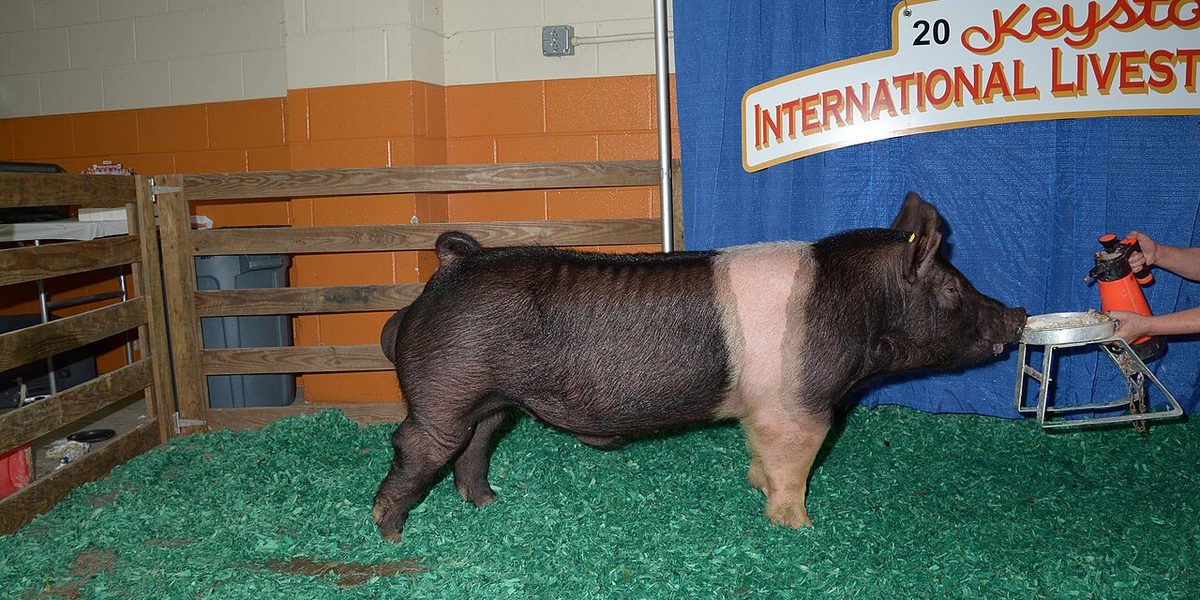
Walk into any large-scale integrator operation in the Philippines — San Miguel Foods, Monterey, Bounty Fresh — and you will see Hampshire genetics in the sire line rotation alongside Duroc. The breed is unmistakable: jet black with a white belt wrapping around the shoulders and front legs. But Hampshire is not here for looks. It is here because it produces some of the leanest, highest-dressing carcasses of any terminal sire, and integrators selling to supermarket chains and meat processors need exactly that.
Hampshire fills a specific niche in Philippine pork production. Where Duroc wins on marbling and flavor, Hampshire wins on leanness and muscling. If your market is modern trade — supermarkets, cold chain, branded fresh pork — Hampshire-sired finishers give you the carcass profile those buyers spec. If your market is lechon and wet market liempo, Duroc is still king. Knowing which tool to use where is the difference between a premium and a commodity price.
At a Glance
| Trait | Value | Notes |
|---|---|---|
| Mature Weight (Boar) | 150–170 kg | Muscular, compact frame |
| Mature Weight (Sow) | 130–150 kg | Not recommended as purebred dam |
| Litter Size | 8–12 piglets | Lower maternal performance than Landrace/LW |
| Days to Market (90–100 kg) | 150–170 days | Hampshire-sired crosses, commercial feeds |
| Feed Conversion Ratio | 2.8–3.1 | Slightly higher than Duroc; still competitive |
| Dressing Percentage | 74–78% | Excellent muscling contributes to high yield |
| Average Daily Gain | 700–850 g/day | Under Philippine commercial conditions |
| Backfat Thickness | 10–15 mm | Notably lean — the breed's defining trait |
| Coat Color | Black with white belt | Belt runs from shoulder across front legs |
Who Is This Breed For?
If you are a contract grower for an integrator, Hampshire-sired weanlings may be what your program supplies. San Miguel, Monterey, and other integrators use Hampshire and Hampshire-cross boar lines in their terminal sire rotations. You do not choose the genetics — the integrator does — but understanding the breed helps you manage them properly. Hampshire-sired pigs are lean and muscular; they need adequate protein to express that genetic potential.
If you supply the modern trade and processed meat market, Hampshire is your terminal sire. Supermarket procurement specs increasingly favor lean carcasses with minimal backfat — 10–15 mm versus 12–18 mm for Duroc. Meat processors making tocino, longganisa, and hotdog want lean raw material they can add fat to, not carcasses they have to trim. Hampshire delivers that.
If you run a crossbreeding program, Hampshire works as a terminal sire on Large White x Landrace F1 dams, the same three-way cross structure used with Duroc. The offspring are lean, fast-growing hybrids with excellent dressing percentage. Some operations rotate Hampshire and Duroc boars across their sow herd to produce both lean and marbled finishers for different market channels.
If you are a backyard farmer with fewer than 20 sows, Hampshire is probably not your breed. Purebred Hampshire boars are harder to find in the Philippines than Duroc, and the lean carcass premium is harder to capture without a direct relationship with modern trade buyers. Stick with Duroc-sired finishers for the wet market.
For a side-by-side breed comparison against Pietrain, Berkshire, and the dam-line breeds before you lock in a terminal-sire program, see our best pig breeds for Philippine small farmers guide.
Sa Bisaya
Terminal Sire Economics: Hampshire vs. Duroc
The decision between Hampshire and Duroc as your terminal sire depends on your market. Here is the cost comparison.
Keeping a Hampshire Boar
| Cost Item | Amount |
|---|---|
| Purchase (proven boar, multiplier farm) | P50,000–P90,000 |
| Annual feed (2.5 kg/day x 365 days x P30/kg) | P27,375 |
| Housing & maintenance | P8,000–P12,000/year |
| Vet care & vaccines | P3,000–P5,000/year |
| Total annual cost (after purchase) | P38,000–P44,000 |
Hampshire boars cost P5,000–P10,000 more than Duroc on average because supply is tighter in the Philippines. Fewer multiplier farms carry purebred Hampshire lines, and most available genetics come through integrator-affiliated breeding programs.
Buying AI Doses
| Cost Item | Amount |
|---|---|
| Hampshire semen dose (fresh, AI center) | P400–P700 per dose |
| Doses per sow per heat (2–3 inseminations) | P800–P2,100 per breeding |
| AI technician fee | P200–P500 per visit |
| Total per breeding | P1,000–P2,600 |
Hampshire semen is less widely available than Duroc in the Philippines. The major AI centers carry it, but provincial technicians may need to order in advance. Plan your breeding calendar accordingly.
Hampshire vs. Duroc: Which Terminal Sire Pays More?
| Factor | Hampshire | Duroc |
|---|---|---|
| Boar purchase cost | P50,000–P90,000 | P45,000–P80,000 |
| Semen dose cost | P400–P700 | P300–P600 |
| Backfat at market weight | 10–15 mm | 12–18 mm |
| Dressing % | 74–78% | 74–78% |
| Marbling (IMF) | 1.5–2.5% | 3.5–5.0% |
| Best market channel | Modern trade, processors | Wet market, lechon, restaurants |
| Price premium potential | P5–P10/kg lean spec | P5–P15/kg marbled pork |
The answer is not which breed is "better." It is which breed matches your buyer. If you sell to SM Fresh, Robinsons Supermarket, or a meat processing plant, Hampshire-sired carcasses fit their specs. If you sell to wet market traders and lechon operators, Duroc-sired carcasses earn more. Some medium-to-large operations keep both lines and sort finishers to different buyers.
A P5–P10/kg lean premium sounds attractive on paper, but it only translates to real money once you put it through your batch-level cashflow against the slightly higher boar/semen cost. Run the numbers in our 10-pig backyard profit guide using your actual feed cost and farmgate price — the Hampshire premium typically clears the Duroc baseline only when you have a confirmed processor or modern-trade contract, not a generic trader.
Feeding Program
Hampshire-sired finishers are genetically lean. They partition nutrients toward muscle rather than fat. This means they need higher protein levels maintained through the finisher phase — if you drop protein too early, you lose the lean muscle advantage you paid for.
Phase 1: Pre-Starter (Birth to 21 days)
| Parameter | Target |
|---|---|
| Crude Protein | 22% |
| Feed Type | Creep pellet, ad libitum from Day 7 |
| Feed Brand Example | B-MEG Pre-Starter, ~P36–P44/kg |
| Target Weight at 21 days | 6–7 kg |
| Total Feed Consumed | 2–4 kg |
| Cost per piglet | P72–P176 |
Hampshire-sired piglets are slightly leaner even at birth. Early creep feeding is critical to support muscle development.
Phase 2: Starter (21–56 days / 7–20 kg)
| Parameter | Target |
|---|---|
| Crude Protein | 20% |
| Feed per Day | Ad lib, transitioning to 0.5–1.0 kg/day |
| Feed Brand Example | B-MEG Starter, ~P33/kg |
| Total Feed Consumed | 16–26 kg |
| Cost per pig | P528–P858 |
Phase 3: Grower (56–112 days / 20–60 kg)
| Parameter | Target |
|---|---|
| Crude Protein | 16–18% |
| Feed per Day | 2.0–2.8 kg |
| Feed Brand Example | B-MEG Grower, ~P32/kg |
| Total Feed Consumed | 95–135 kg |
| Cost per pig | P3,040–P4,320 |
Hampshire-sired pigs stay lean through the grower phase. Unlike Duroc, you are unlikely to see excessive backfat deposition here. Maintain protein levels — do not be tempted to switch to finisher rations early.
Phase 4: Finisher (112–170 days / 60–100 kg)
| Parameter | Target |
|---|---|
| Crude Protein | 15–16% |
| Feed per Day | 2.8–3.8 kg |
| Feed Brand Example | B-MEG Finisher, ~P30/kg |
| Total Feed Consumed | 135–185 kg |
| Cost per pig | P4,050–P5,550 |
Total Feed Cost Summary
| Phase | Feed (kg) | Cost (PHP) |
|---|---|---|
| Pre-Starter | 2–4 | P72–P176 |
| Starter | 16–26 | P528–P858 |
| Grower | 95–135 | P3,040–P4,320 |
| Finisher | 135–185 | P4,050–P5,550 |
| Total | 248–350 kg | P7,690–P10,904 |
At 90–100 kg liveweight sold at P180–P183/kg commodity, gross revenue is P16,200–P18,300 per head. With a lean carcass premium of P5–P10/kg from modern trade buyers, revenue rises to P16,650–P19,300. Feed margin ranges from P5,746–P11,610 depending on management and market channel. Net margin after all costs for a well-run operation: P1,800–P4,500 per head.
Read the full feed economics breakdown for detailed cost analysis across breeds.
Health & Management
Hampshire-Specific Considerations
Hampshire pigs are generally hardy, but the breed has specific management needs in Philippine conditions:
-
Leg soundness at heavier weights. Hampshire carries more muscle on a compact frame. As pigs approach market weight (90–100+ kg), leg and joint stress increases — particularly in the hind legs. Watch for stiffness, reluctance to stand, or uneven gait. Concrete flooring without rubber mats worsens the problem. If you see lameness, market the pig immediately rather than holding for additional weight gain.
-
Heat stress management. The black coat absorbs more solar radiation than white breeds. In open or semi-open housing, provide adequate shade and cooling — drippers, sprinklers, or wallows. Hampshire pigs in direct Philippine sun (especially during March-May) will reduce feed intake, slowing growth and worsening FCR.
-
Stress susceptibility. Hampshire carries the halothane gene (Hal-1843) at higher frequency than most breeds. Pigs with one or two copies of this gene are more susceptible to transport stress and PSE (pale, soft, exudative) meat. Avoid rough handling, overcrowded transport, and mixing unfamiliar pigs before slaughter. Reputable breeding programs select against this gene, but ask your genetics supplier for Hal status.
Vaccination Schedule
The vaccination program for Hampshire-sired pigs is identical to other commercial breeds:
| Vaccine | Timing | Notes |
|---|---|---|
| Mycoplasma | Day 7, booster Day 28 | Prevents enzootic pneumonia |
| Hog Cholera (CSF) | Day 45, booster Day 90 | Mandatory in PH |
| PRRS | Before breeding (sows/gilts) | If farm is PRRS-positive |
| Parvovirus | Gilts before first breeding | Prevents mummified piglets |
| Erysipelas | Annually (boars and sows) | Standard protocol |
| E. coli | Sows, 2 weeks pre-farrowing | Protects neonatal piglets |
| Circovirus (PCV2) | Day 21–28 | Increasingly standard in PH |
African Swine Fever (ASF)
Hampshire has zero natural resistance to ASF — no breed does. The same non-negotiable biosecurity measures apply: zero swill feeding, vehicle disinfection, 30-day quarantine for new stock, perimeter fencing, and dedicated farm footwear. Read the full ASF recovery guide for current protocols.
Sourcing Hampshire Genetics in the Philippines
Hampshire genetics are less widely available than Duroc in the Philippines. Most purebred Hampshire lines are maintained by integrators and their affiliated multiplier farms, not by independent breeders.
Primary Sources
| Source | Location | Product | Notes |
|---|---|---|---|
| San Miguel Foods (B-MEG Genetics) | Bulacan, Tarlac | Boars, semen, contract grower weanlings | Hampshire in terminal sire rotation |
| Monterey (Purefoods-Hormel) | Bulacan, Nueva Ecija | Semen, contract grower programs | Hampshire-Pietrain cross sire lines |
| INFARMCO | Bulacan | Boars, semen | Carries Hampshire alongside Duroc/Pietrain |
| PIC Philippines | Batangas, Bulacan | Semen, technical support | Hampshire-based sire lines in portfolio |
| BAI-accredited multiplier farms | Central Luzon, CALABARZON | Boars, semen | Check BAI registry for current list |
Integrator Contract Growing Programs
The most accessible path to Hampshire genetics in the Philippines is through an integrator contract growing program. Companies like San Miguel and Monterey supply weanlings (often Hampshire-sired), feed, and veterinary support. You provide the housing and labor. The economics:
| Item | Typical Terms |
|---|---|
| Weanling supply | Free (integrator-owned) |
| Feed supply | Integrator-supplied, deducted from payment |
| Vet & medicines | Integrator-supplied, deducted from payment |
| Grower fee (your income) | P35–P55 per kg liveweight gained |
| Pigs per cycle | 300–1,000 head (depending on facility) |
| Cycle length | 100–120 days (grower-finisher) |
Contract growing removes genetics sourcing, feed purchasing, and marketing risk. The tradeoff is lower margin per head — you earn a fixed grower fee rather than capturing the full market price. But for farmers without capital for independent operations, it is a proven entry point.
Regional Availability
- Central Luzon (Bulacan, Pampanga, Tarlac): Best availability. Integrator breeding farms and major AI centers are concentrated here.
- CALABARZON (Batangas, Laguna): Good availability through PIC Philippines and integrator satellite farms.
- Visayas and Mindanao: Limited. Hampshire genetics must be shipped from Luzon. AI with fresh semen is possible but requires advance coordination. Contract growing programs from San Miguel and Monterey operate in major Visayas and Mindanao cities, which is the most practical access route.
Common Mistakes
1. Using Hampshire as a Maternal Line
This is the most expensive mistake you can make with Hampshire. The breed has smaller litters (8–12) and lower milk production than Landrace or Large White. Every farrowing, you lose 2–4 piglets compared to an F1 dam. Hampshire is a terminal sire — period. Mate Hampshire boars to F1 Large White x Landrace dams. Never the other way around.
2. Over-Finishing Hampshire-Sired Pigs
Hampshire's advantage is leanness. If you hold pigs past 100 kg hoping for extra revenue, they start depositing more backfat and you lose the lean carcass premium that justified the genetics. Market Hampshire-sired finishers at 90–100 kg. Do not apply the Duroc strategy of extending the finisher phase for marbling — that works for Duroc because marbling is its strength. Hampshire's strength is lean muscle, and over-finishing erases it.
3. Feeding Low-Protein Finisher Rations
Hampshire-sired pigs need 15–16% CP through the finisher phase. Dropping to 13–14% CP (acceptable for Duroc) starves Hampshire genetics of the amino acids needed for lean tissue deposition. The result: a carcass with neither Hampshire's leanness nor Duroc's marbling. You get a generic pig from premium genetics. Budget for higher-protein finisher feed or the entire Hampshire investment is wasted.
4. Ignoring Leg Soundness
Hampshire's muscular build puts more stress on joints and feet than lighter-framed breeds. On Philippine farms with concrete flooring (the norm), lameness can show up as early as 80 kg. Rubber mats in finishing pens cost P500–P800 per mat but prevent lameness that forces you to sell at a discount. Check feet and legs weekly from 70 kg onward.
5. Selling to the Wrong Market
Hampshire-sired lean carcasses are worth a premium to supermarket buyers and meat processors. They are worth nothing extra to a wet market trader or lechon operator who wants marbled pork. If you raise Hampshire-sired pigs and sell through the wet market viajero system, you are paying for premium genetics and getting commodity prices. Know your buyer before choosing your sire line.
FAQ
Magkano ang purebred Hampshire boar? Proven purebred Hampshire boars from multiplier farms cost P50,000–P90,000 — roughly P5,000–P10,000 more than equivalent Duroc boars because fewer farms carry the line. Young unproven boars (8–10 months) may be available for P35,000–P60,000. Always demand pedigree documentation and health certificates. Source from BAI-accredited farms or integrator breeding programs only.
Hampshire ba o Duroc ang mas maayo para sa terminal sire? Depends on your market. Hampshire produces leaner carcasses with less backfat (10–15 mm vs. 12–18 mm) — ideal for supermarkets and meat processors. Duroc produces more marbled pork (3.5–5.0% IMF vs. 1.5–2.5%) — ideal for lechon, wet market liempo, and restaurant supply. Neither breed is universally "better." The best operations use both and sort finishers to the right market channel.
Can I cross Hampshire with Native pigs for lechon? You can, but it is not the best cross for lechon. Hampshire's low intramuscular fat means less marbling, and lechon needs marbling for flavor and juiciness. Duroc x Native is the superior lechon cross. Hampshire x Native would produce a lean, muscular pig better suited to processed meat than whole roasting.
How do I identify Hampshire-sired piglets? The white belt is the giveaway. Hampshire-sired crossbreds almost always show some version of the white shoulder belt, even when the dam is a solid-colored breed. The belt may be partial or broken, but it is usually visible. Black skin with white markings on the front half of the body is a strong indicator. Ask for breeding records to confirm.
Pila ka bulan before ma-market ang Hampshire cross? Hampshire-sired commercial crosses reach 90–100 kg in 150–170 days (about 5–5.5 months) under good management with quality feeds. This is slightly slower than Duroc-sired crosses (150–165 days) because Hampshire's FCR is marginally higher (2.8–3.1 vs. 2.7–3.0). The difference is 5–7 days — not significant enough to change your production planning.
Is Hampshire good for backyard farming? Hampshire-sired finishers can be raised in backyard settings, but the lean carcass premium is hard to capture without a direct buyer relationship. Backyard farmers typically sell through viajeros (traders) at commodity prices, where Hampshire's leanness earns no premium. If you are a backyard farmer, Duroc-sired weanlings are a more practical choice — the marbling premium is easier to capture even through wet market channels.
Where can I buy Hampshire semen for AI? Contact INFARMCO (Bulacan), PIC Philippines (Batangas), or your integrator's breeding division. Hampshire semen costs P400–P700 per dose — slightly more than Duroc (P300–P600) due to tighter supply. Provincial AI technicians may need to order Hampshire semen in advance; it is not as widely stocked as Duroc. Plan breedings at least 2 weeks ahead, especially outside Central Luzon.
What is the National Swine Registry Hampshire standard? The NSR standard calls for a black pig with a white belt encircling the body at the shoulder, including both front legs. The belt should be continuous (no breaks). Ears are erect. The body is muscular and trim with a long, level rump. Philippine multiplier farms that import Hampshire genetics generally adhere to these standards, but confirm with pedigree documentation rather than visual assessment alone.
Sa Bisaya