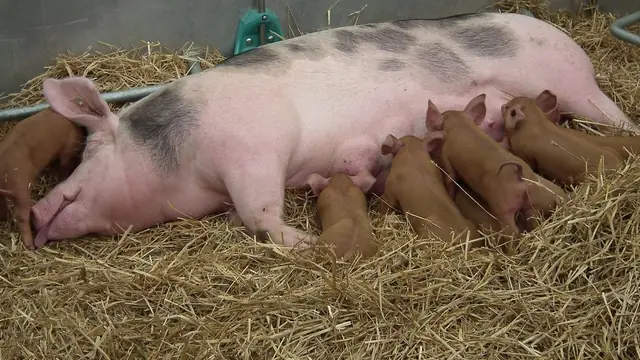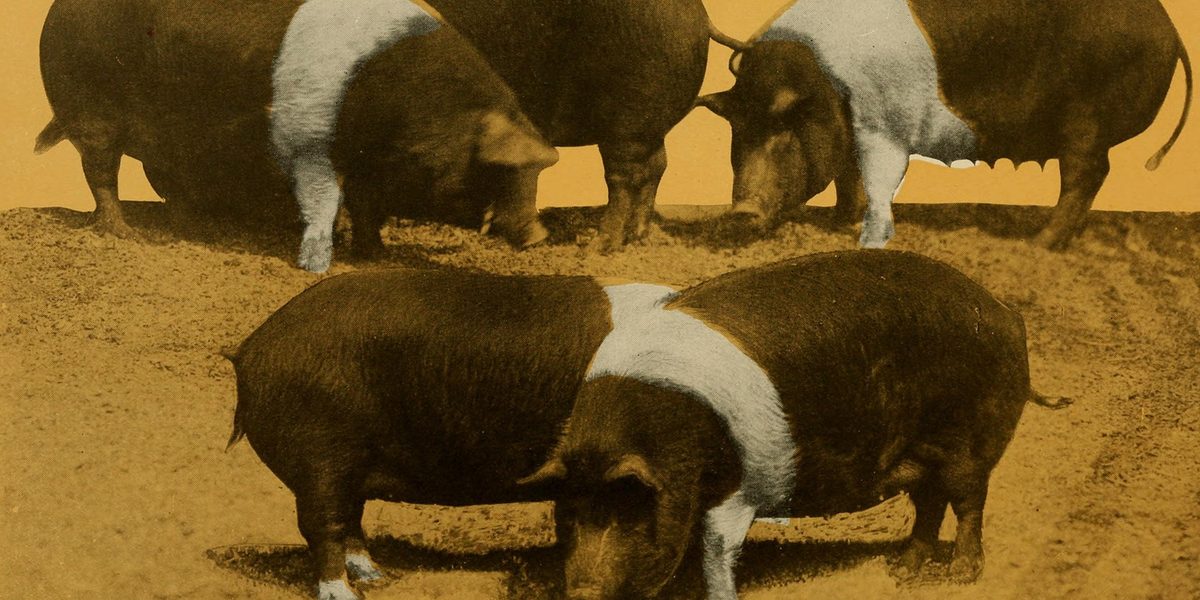
A Duroc-sired pig and a Hampshire-sired pig from the same Landrace x Large White sow look nearly identical at 90 kg liveweight, and the trader pays the same farmgate price at the wet market. Carve them up and you get different products: Duroc gives marbled, flavorful meat the lechonero wants; Hampshire gives a leaner carcass the supermarket processor specs.
For most Filipino raisers, Duroc is the right call, and the research backs that. But not for everyone. Below is exactly when each terminal sire is the better fit, with the backyard reality numbers, not just the brochure ones.
Free Tool
Pig Profit Simulator
Run the profit simulator with your real buyer's price point: wet-market commodity vs integrator contract vs lechon premium. The terminal sire choice can move per-pig margin by P500 to P2,000.
At-a-Glance Comparison
| Trait | Duroc | Hampshire |
|---|---|---|
| Origin | USA (New York/New Jersey) | USA (from Hampshire, England) |
| Color | Red/auburn | Black with white belt |
| Ears | Slightly drooping | Erect |
| Heat tolerance | Best of commercial sire breeds | Moderate |
| Days to ~90 kg (PH commercial) | 150-165 | 150-170 |
| FCR (PH commercial) | 2.7-3.0 | 2.8-3.1 |
| Dressing % (PH commercial) | 74-78% | 74-78% (excellent muscling) |
| Backfat thickness | 12-18 mm (marbled) | 10-15 mm (lean) |
| Intramuscular fat | ~3.5-5.0% | ~2.0-3.0% |
| Meat quality | Marbled, flavorful, juicy | Lean, mild, can run pale |
| Best market | Lechon, wet market, restaurant | Supermarket, processor |
| Boar price (2026, est.) | P45,000-P80,000 | P40,000-P70,000 |
| AI semen (per dose, est.) | P600-P1,500 | P600-P1,500 |
| Philippine availability | Widely available | Limited (integrator-focused) |
The trade-off is simple. Duroc gives marbling and flavor for traditional markets. Hampshire gives leanness and tight muscling for modern-trade buyers. Note one thing most comparison posts get wrong: dressing percentage between the two is close under Philippine conditions (74-78% for both). The old claim that Hampshire dresses out at 80% comes from controlled foreign trials, not backyard pens here. Don't pick Hampshire for a yield edge that mostly disappears on a real farm.
The Backyard Reality Gap (Read This First)
The numbers above are commercial figures, the kind a well-run multiplier or contract farm hits with quality genetics, full commercial feed, and competent management. Backyard performance is routinely 30-50% lower. Published controlled Duroc ADG sits around 880 g/day; in a typical backyard pen on partial commercial feed, expect closer to 600-750 g/day, and FCR drifting from 2.8 toward 3.5+ when you cut corners on feed or genetics.
This matters for the Duroc-vs-Hampshire decision because Hampshire's whole case is a tighter carcass spec for a contract. If your management can't even hit Duroc's commercial range, you almost certainly can't hit a processor's lean spec consistently with Hampshire either. Fix management before you chase a leaner sire. (See our best pig breeds for small farmers for the full reality-gap table.)
Where Duroc Wins
1. Lechon and Roast-Pig Markets
This is Duroc's strongest position in the Philippines. Its intramuscular fat, roughly 3.5-5.0% versus 1.5-2.5% for Large White and 2.0-3.0% for Landrace, renders during roasting and bastes the meat from inside. That produces the moist interior and crackling skin proper Filipino lechon needs. Research comparing Duroc and crossbred pigs found Duroc carcasses scored higher on marbling, juiciness, and flavor, with lower drip loss and cooking loss (Korean Journal for Food Science of Animal Resources, 2015).
A Duroc x Native F1 raised to ~60 kg can sell as lechon-grade for roughly P12,000-P16,000 versus about P10,800-P11,000 at commodity farmgate, a P1,000-P5,000 per-head premium when you have the lechonero connection. The marbling is the reason that premium exists.
2. Wet-Market Liempo and Pork Belly
Home cooks pick marbled liempo for sinigang, adobo, sisig, and lechon kawali. Duroc-sired belly shows visibly more intramuscular fat, which holds moisture and flavor through slow cooking. Vendors who can point to that marbling sometimes hold a small retail edge over generic commercial pork. It is not a huge premium, but it is real, and it is repeat business.
3. Heat Tolerance
Duroc handles Philippine heat better than the other commercial sire breeds. The breed came up in the hot, humid American South, and that shows in feed-intake stability during the worst of the dry-season heat. For backyard pens without tunnel ventilation or active cooling, that stability is worth more than a small carcass-yield difference. Hampshire and especially Pietrain back off feed harder when the barn gets hot.
4. Hybrid Vigor in the Three-Way Cross
The standard Philippine commercial cross is an F1 (Landrace x Large White) sow bred to a Duroc terminal sire:
- Maternal traits from the F1 dam: decent litter size, good mothering
- Growth and meat quality from Duroc: faster grow-out than purebreds, marbled meat
- Hybrid vigor across the whole package
Roughly 8 of 10 commercial pigs slaughtered in the Philippines come out of this structure. For traditional-market production, Duroc's role in it is settled, not a debate. See our three-way cross guide for what those finishers actually look like.
5. Sourcing and Genetics Availability
Duroc is the most widely available terminal sire here. Multipliers in Bulacan, Pampanga, Tarlac, Cebu, and Davao carry Duroc lines, AI semen is broadly distributed through BAI-accredited centers and private AI services, and boar replacement is straightforward. Hampshire is none of those things outside the integrator network.
Where Hampshire Wins
1. Supermarket Fresh-Pork Contracts
Modern-trade buyers (SM, Robinsons, Puregold, Landers) spec lean, well-muscled carcasses for their fresh-pork programs, typically backfat under ~15-18 mm with high lean meat percentage. Hampshire hits that spec more consistently than Duroc. Farms supplying these chains, directly or through an integrator program, lean on Hampshire (or Pietrain x Duroc) for exactly this reason.
2. Processor Contracts (Sausage, Hot Dog, Tocino)
CDO, Pampanga's Best, Purefoods, and other large processors buy lean-spec pork for sausage, hot dog, tocino, and longganisa. Leaner input gives them more formulation room, since they add controlled fat back rather than trimming it out. A processor contract typically pays a premium over wet-market farmgate for spec-compliant lean pork. Across a 10-pig batch that adds up, but only if you actually hold the contract.
One caution specific to Hampshire. Many Hampshire lines carry the RN gene (the "Napole" or "acid meat" gene). RN-carrier pigs show lower ultimate pH, poorer water-holding, and higher cooking loss (research on RN-carrier Hampshire-sired pigs reports cooking loss around 22.7% vs 19.3% for non-carriers). That hurts cured-product yield and lechon quality. If you go Hampshire, ask the multiplier whether the line is RN-tested and select RN-negative.
3. Lean-Carcass Yield, Honestly Stated
Hampshire's edge here is tight muscling and low backfat (10-15 mm vs 12-18 mm for Duroc), not a big dressing-percentage gap. Under Philippine conditions both dress out around 74-78%. The real Hampshire advantage is a higher lean cut-out for a buyer who pays per lean kg, which is a contract buyer, not the wet market. For the trader at the palengke, this advantage is invisible and unpaid.
4. Health-Lean Urban Niche
A small but growing Metro Manila and major-city segment, gym meal-prep services, health-focused retailers, some restaurants, pays up for lean cuts. Hampshire-sired pork fits that position better than Duroc. It is a niche, not a volume play, but for a farm already inside modern trade it can be a useful add-on channel.
When to Choose Duroc
Choose Duroc if any of these is true:
- You sell mostly to wet markets, traders, or local consumers
- Lechon is 10%+ of your sales channel
- You have minimal cooling infrastructure
- You're in a region with thin Hampshire genetics supply
- You're running the standard three-way cross commercial program
That covers roughly 80-90% of independent Filipino farms. If you're not sure which side you're on, you're on this side.
When to Choose Hampshire
Choose Hampshire only if you can tick a contract box:
- You hold a supermarket fresh-pork contract
- You're a contract grower for an integrator that specs lean carcasses
- You sell direct to a processor (CDO, Pampanga's Best, etc.)
- You have good cooling (tunnel ventilation)
- You're in Central Luzon with real access to Hampshire multipliers
- You're targeting the health-lean urban retail channel
No contract on that list? Don't buy the Hampshire boar. The lean premium has nowhere to go and the investment just sits there.
What About Using Both?
Multi-channel farms (traditional and modern trade) sometimes run both Duroc and Hampshire, by separate boars or rotating AI:
- Duroc-sired litters to wet market, lechon, restaurant
- Hampshire-sired litters to supermarket and processor
It needs two boars or a managed AI rotation, sow-by-sire record keeping, and marketing into two buyer channels. For most backyard farms under 50 sows the complexity costs more than it returns. Stick to one sire matched to your primary buyer. For 50+ sows with genuine multi-channel demand, splitting can lift overall revenue by matching each pig to its highest-paying market, mainly because you stop selling lechon-grade marbling at commodity prices.
A Note on Pietrain
The third commercial terminal sire here is Pietrain: the leanest carcass of the three, but the most heat-sensitive and most management-intensive, and prone to stress (the halothane gene). It is rare in Philippine production and mostly used in Pietrain x Duroc crosses to pull leanness without losing all heat tolerance. For most readers of this comparison it is not a real option. See our Pietrain breed guide for the full profile.
Sourcing in 2026
Duroc (Philippines):
- Widely available through Central Luzon multipliers, plus Cebu and Davao lines
- Provincial multipliers in Bulacan, Pampanga, Tarlac
- AI semen distributed through BAI-accredited centers and private AI services
- Red coat alone does not prove Duroc. Demand pedigree, farm of origin, health certificates, and performance records
Hampshire (Philippines):
- Limited, mostly through integrator-affiliated multipliers
- Expect a multi-month lead time for a live boar
- Ask specifically whether the line is RN-tested and buy RN-negative
Always verify breeder credentials, request performance records, check ASF-status certification with the seller, and physically inspect the boar before purchase. A breeding boar is the single most expensive non-housing asset on the farm. Don't compromise the sourcing to save a few pesos on a transport trip. The cheap boar with no records is the expensive boar two litters later.
Bisaya / Cebuano
Para sa mga Mag-uuma
Duroc ba o Hampshire?
Lain ang merkado. Walay basta "mas maayo". Naa kini sa kinsa imong baligyaan.
Pili-a ang Duroc kung:
- Magbaligya ka sa palengke, lechon, o restaurant
- Daghan kag buyer nga gusto sa marbled liempo. Kasagaran Filipino consumers
- Limited ang cooling sa imong farm. Mas hardy ang Duroc sa init
- Standard 3-way cross imong gusto. Landrace x Large White F1 sow ug Duroc boar
Mao kini ang 80 ngadto sa 90 porsyento sa Filipino independent farms.
Pili-a ang Hampshire kung:
- Naa kay supermarket contract. SM, Robinsons, Puregold
- Contract grower ka sa integrator nga nagkinahanglan og lean carcass
- Magbaligya direkta sa processor. CDO, Pampanga's Best
- Naa kay maayong cooling, tunnel ventilation
Mga niche:
- Lechon: Duroc gyud, walay debate. Ang marbled fat ug pula nga karne mao gyud ang gusto sa lechonero.
- Supermarket o processor contract: didto lang molihok ang Hampshire. Kung walay contract, ayaw.
Importante: Ayaw pagpalit og Hampshire boar kung walay ka supermarket o processor contract. Mausik lang ang kuwarta. Para sa kasagaran nga raiser, Duroc gihapon ang sakto.
Presyo sa boar, 2026 (banabana):
- Duroc: mga P45,000 hangtod P80,000
- Hampshire: mga P40,000 hangtod P70,000
- AI semen: mga P600 hangtod P1,500 kada dose
Pangutan-a ang accredited multiplier sa karon nga presyo. Magbalhinbalhin ni depende sa genetics ug demand.
Related Reading
- Duroc Breed Guide for feeding, sourcing, and management detail
- Hampshire Breed Guide for the integrator economics
- Pietrain Breed Guide for the third terminal sire option
- Three-Way Cross Guide for what Duroc-sired commercial pigs look like
- Landrace vs Large White for choosing the maternal line
- Best Pig Breeds for Small Farmers for the backyard reality-gap table
- Contract Growing ng Baboy for when Hampshire matters
Run the numbers on your own buyer before you commit a boar: the profit simulator and break-even calculator will tell you fast whether a lean-spec contract actually beats the wet-market price you can get today.
Sources
- Korean Journal for Food Science of Animal Resources (2015), Comparison of Carcass Characteristics and Meat Quality between Duroc and Crossbred Pigs: Duroc vs crossbred backfat (~22 mm), fat content (~3.0% vs ~2.2%), marbling, juiciness, drip and cooking loss.
- Lundström et al., Effect of the RN gene on technological and sensory meat quality in crossbred pigs with Hampshire as terminal sire: RN ("Napole"/acid-meat) gene effects on pH, water-holding, and cooking loss in Hampshire-sired pigs.
- DOST-PCAARRD, Swine R&D program: Philippine swine improvement and terminal-sire context.
- USDA FAS, Philippines Livestock and Products Annual 2025: Philippine swine industry and production context.
Boar and AI semen peso figures are 2026 market estimates and move with line, age, records, and demand; confirm current pricing directly with the BAI-accredited multiplier before purchase.