For roughly 80% of Filipino commercial farms the answer is neither one alone: they raise the Landrace x Large White F1 sow, which runs 10-15% more productive than either purebred at the same ₱18,000-₱25,000 gilt price. Both breeds came out of Northern Europe and serve the same job, so the real question is placement, not winner.
Each parent has subtle, measurable advantages. Landrace milks and mothers better; Large White grows a touch faster with a slightly tighter feed conversion. Put together, the cross beats both.
Below is the honest side-by-side, with the backyard reality numbers, and a clear call on which breed (or which cross) fits your operation.
Both breeds are white-skinned and Northern European, so neither is heat-adapted. A Landrace sow run through a Philippine summer without sprinklers, drip cooling, or real ventilation will give you smaller litters and lower conception rates, F1 or not.
Free Tool
Pig Setup Planner
The setup planner asks 8 questions and recommends a breed mix matched to your scale, market channel, and management capacity. Try it for the breeding-stock decision before buying a single gilt.
At-a-Glance Comparison
| Trait | Landrace | Large White (Yorkshire) |
|---|---|---|
| Origin | Denmark | England |
| Ears | Drooping (forward) | Erect |
| Body Length | Longer (more vertebrae) | Shorter |
| Skin Color | White, slightly thicker | White, thinner |
| Heat Tolerance | Slightly better | More sensitive |
| Born Alive (avg) | 11-13 per litter | 10-14 per litter |
| Weaned Piglets (avg) | 10-11 per litter | 9-12 per litter |
| Milk Production | Excellent | Good to very good |
| Mothering Instinct | Strong | Moderate |
| Days to 90 kg (commercial) | 155-170 | 150-165 |
| Feed Conversion (FCR) | 2.9-3.3 | 2.8-3.2 |
| Dressing Percentage | 73-76% | 72-76% |
| Carcass: Backfat Thickness | 18-22 mm | 18-22 mm |
| Weaner Price (2026, 10-12 kg) | ₱3,000-₱4,000 | ₱3,000-₱4,000 |
| Gilt Price (2026) | ₱18,000-₱25,000 | ₱18,000-₱25,000 |
| Best Used As | Maternal line, F1 cross | Maternal line, F1 cross |
The breeds are remarkably similar. The differences are subtle but real.
Where Landrace Wins
1. Mothering Ability and Milk Production
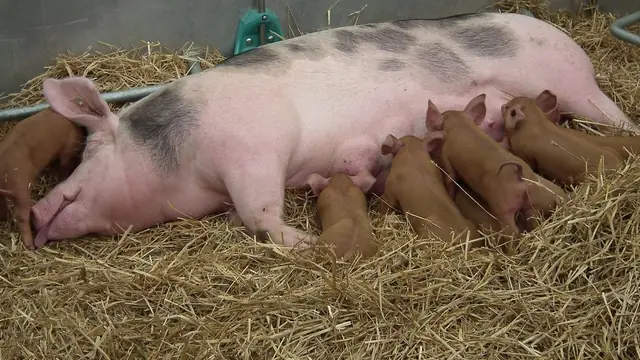
Landrace sows have a measurable advantage in lactation. They produce more milk per litter on average and mother harder. They stay calmer at farrowing, crush fewer piglets, and pay closer attention to the litter through weaning. Researchers call Landrace females "the sowherd" for a reason.
For backyard operations where farrowing supervision is limited (no farrowing crate, no dedicated farrowing operator), this matters. A first-time backyard breeder will lose fewer piglets to crushing and rejection with Landrace than with Large White.
2. Heat Tolerance (Marginally)
Landrace has drooping ears that provide some shade over the eyes and the front of the body. The skin is slightly thicker than Large White. In Philippine tropical conditions, this translates to roughly 5-10% less heat-stress-related feed-intake reduction during the hottest months.
Both breeds still need active cooling in lowland Philippines: sprinklers, fans, shade. The difference is not "Landrace handles heat fine and Large White doesn't." It's "Landrace handles heat marginally better, and both still need cooling." Don't read too much into the gap.
3. Body Length (For Bacon-Type Carcass)
Landrace has one extra vertebra compared to Large White (16 vs 15 thoracic vertebrae on average). The longer body produces longer pork loins, which matters for processors making bacon strips or premium fresh-cut loins.
For Philippine wet-market pork (sold in standard cuts), this advantage is minimal. For processor contracts (CDO, Pampanga's Best, San Miguel processed products), the longer loin commands a small premium.
Where Large White Wins
1. Growth Rate and Feed Conversion
Large White reaches 90 kg market weight roughly 5-10 days faster than Landrace under identical feeding programs. The feed conversion ratio is also marginally better (2.8-3.2 vs 2.9-3.3 for Landrace).
Over a full grow-out cycle, this difference adds up to ₱200-₱400 in feed savings per pig and roughly ₱600-₱1,000 in faster cycle turnover (you can run more cycles per year). That saving only holds at the feed price you actually pay, and the dated listing we keep is one retailer on one day, because there is no national finished-feed price to quote instead.
2. Standardization and Commercial Sourcing
Large White is the most widely-bred commercial breed in the Philippines. INFARMCO, Family Farms (Topigs Norsvin), PIC Philippines, and most provincial multipliers carry Large White genetics. Sourcing is easier, prices are more competitive, and genetic merit is more consistent.
Landrace genetics are also widely available but slightly less so. For Visayas and Mindanao buyers, Landrace gilts often need to be sourced from Luzon multipliers, adding transport cost.
3. Litter Size (At the Upper End)
While average litters are similar, Large White hits the upper range a little more consistently. Genome-wide work across both breeds found Large White weaned about 3.7% more pigs than Landrace. In practice, a productive Large White at third parity edges out a Landrace by roughly one piglet per litter. Multiply that by 2.2 litters a year and you get about 2 extra weaners per sow per year, worth around ₱7,000 at ₱3,500 each. Real, but not decisive on its own.
The F1 Cross: Why Most Farms Use Both
Here's the answer to "which is better": neither, when used alone, beats the F1 cross.
A Landrace x Large White F1 gilt (often abbreviated LR x LW or LWxLR depending on which is the dam) combines:
- Landrace's mothering and milk production
- Large White's growth rate and litter size
- Hybrid vigor (10-15% performance lift over either parent)
The standard Philippine commercial three-way cross uses an F1 (LR x LW) sow bred to a Duroc terminal sire:
- F1 dam = maternal traits from Landrace + Large White
- Duroc sire = terminal growth and meat quality
- Three-way cross piglets = inherit all three breeds' strengths
This is the breed structure used by 80%+ of commercial Philippine pig operations and by every major integrator (San Miguel, Monterey, CPF, Bounty Fresh).
Keep that in proportion, though, because "industry standard" is doing a lot of work in that sentence. PSA's commercial swine inventory held about 1.7 million head on 1 July 2026, against roughly 7.1 million in the smallhold classification. The three-way cross is standard in an industry that holds under a fifth of the country's pigs.
When to Choose Pure Landrace
A few specific situations favor pure Landrace over Large White or F1:
- Bacon and processor markets. The longer body produces longer loins valued by processors.
- First-time breeders. Stronger mothering cuts year-1 piglet mortality, which is where most new breeders bleed money.
- Open-air housing with limited cooling. The marginal heat tolerance helps when you can't afford tunnel ventilation.
- Visayas and Mindanao operations. If transport from Luzon multipliers is expensive, source from a regional Landrace multiplier rather than waiting on F1 gilts shipped from up north.
When to Choose Pure Large White
A few situations favor pure Large White:
- Tight feed cost margins. The slightly better FCR matters once you're feeding hundreds of pigs.
- Tunnel-ventilated housing. Cooling infrastructure offsets the heat sensitivity.
- Multiplier farm operation. Standardized genetics are easier to manage and sell.
- Maximum throughput goals. Faster cycle turnover lets you run more pigs per year.
Why the F1 Cross Wins for Almost Everyone Else
For 90% of Filipino backyard and small-commercial farms, the F1 (Landrace x Large White) cross is the right choice. The reasons:
- Same price as purebreds. Multiplier farms sell both at ₱18,000-₱25,000.
- Hybrid vigor adds 10-15% to production metrics. More piglets, better growth, lower mortality.
- Cross to a Duroc sire for the standard 3-way commercial cross. Plug-and-play commercial pig.
- Maximum genetic flexibility. Sell weaners as F1, or fatten through to the 3-way.
Running an operation under 50 sows and not multiplying your own stock? Just buy F1 gilts. The pure-vs-pure debate is a problem for the multiplier farms that supply you, not for you. Spend the energy on housing and feed instead.
A Note on Sourcing
In 2026, the major Philippine sources of Landrace, Large White, and F1 gilts:
Luzon-based:
- INFARMCO (Tiaong, Quezon). Pure Landrace and Large White nucleus herd.
- Family Farms (Topigs Norsvin). Topigs LR and LW lines through the multiplier network.
- PIC Philippines. PIC genetic lines (LW-based maternal line) for commercial integrators.
- Various provincial multipliers. F1 gilts at local market pricing.
Visayas and Mindanao:
- Limited pure-breed multipliers; most operate as F1 multipliers sourced from Luzon nucleus farms
- Cebu, Iloilo, Davao have regional gilt suppliers
Always verify ASF-free status (BAI certification or municipal vet clearance), check performance records (dam's litter size, sire's FCR), and physically inspect gilts before purchase. See our Large White breed guide and Landrace breed guide for full sourcing details.
Bisaya / Cebuano
Para sa mga mag-uuma
Landrace ba o Large White?
Para sa kasagaran nga farmer, dili ni mao ang tama nga pangutana. Ang tama: F1 cross sa Landrace x Large White. Kana ang pinakamaayong gilt para sa Pilipinas.
Mga importante:
-
Parehas ra og presyo ang Landrace gilt, Large White gilt, ug F1 gilt (₱18,000-₱25,000). Pero ang F1 mas dako og produksyon (10-15% mas maayo) kay sa pure breed. Free upgrade.
-
Pulihay og Duroc boar ang F1 sow para makahimo og three-way cross. Kana ang standard commercial pig sa Pilipinas (mga 80% sa mga komersyal nga baboy).
-
Pure Landrace mas maayo kung: bag-o ka pa nga breeder (mas hayahay ang mothering), gusto kay long body para sa bacon market, o gamay ra ang cooling infrastructure.
-
Pure Large White mas maayo kung: dako ang operation (50+ sows), naa kay tunnel ventilation, o multiplier farm ka.
Pinakaimportante: Ayaw pagpalit og pure-breed gilt kung dili ka multiplier. Pagpalit og F1 gilt sa established multiplier. Parehas ra og bayad, pero mas dako ang kita.
Saan makapalit:
- Luzon: INFARMCO (Bulacan), Family Farms (Topigs Norsvin), PIC Philippines
- Visayas/Mindanao: Regional multipliers nga nagagikan sa Luzon nucleus farms
Ayaw kalimti: i-check ang ASF-free status sa source farm. Pangutan-a og performance records. Tan-awa ang baboy sa kaugalingon nimo ayha mopalit.
Related Reading
- Large White Breed Guide: full breed page for Large White (Yorkshire)
- Landrace Breed Guide: full breed page for Landrace
- Duroc Breed Guide: the standard terminal sire for 3-way crosses
- Hybrid Three-Way Cross: what F1 dams crossed to Duroc sires produce
- Best Pig Breeds Philippines: full breed comparison for backyard farmers
- Sow vs Fattener Profit Math: when to invest in breeding stock
- Profit Simulator: model F1 vs purebred returns before you buy
- Break-Even Calculator: check how many extra weaners pay back a better gilt
Sources
- Reproductive performance and litter-size models in Landrace sows under tropical conditions (Animal Bioscience): 258 Landrace sows, 2,322 farrowings, overall 10.5 born alive, peak 11.4 at parity 4.
- Parity, season and sex effects on F1 Large White x Landrace litters (Veterinary World): F1 litter size, birth weight, and pre-weaning mortality by parity and season.
- Comparative performance of Landrace, Yorkshire and Duroc under tropical conditions (J. Indonesian Tropical Animal Agriculture): Yorkshire and Landrace comparable for ADG, FCR and age at 90 kg.
- Sow productivity of market hog and Landrace x Large White F1 crossbreds (Philippine EJournals / UPLB): Philippine F1 vs straightbred sow productivity data.
- Genome-wide association for piglets born alive in Large White and Landrace (PLOS ONE): Large White weaned ~3.7% more pigs than Landrace.
- Crossbreed pig price Philippines 2026 (Baboy PH): current ₱3,000-₱4,000 F1 weaner and ₱19,800-₱33,000 gilt liveweight pricing.